
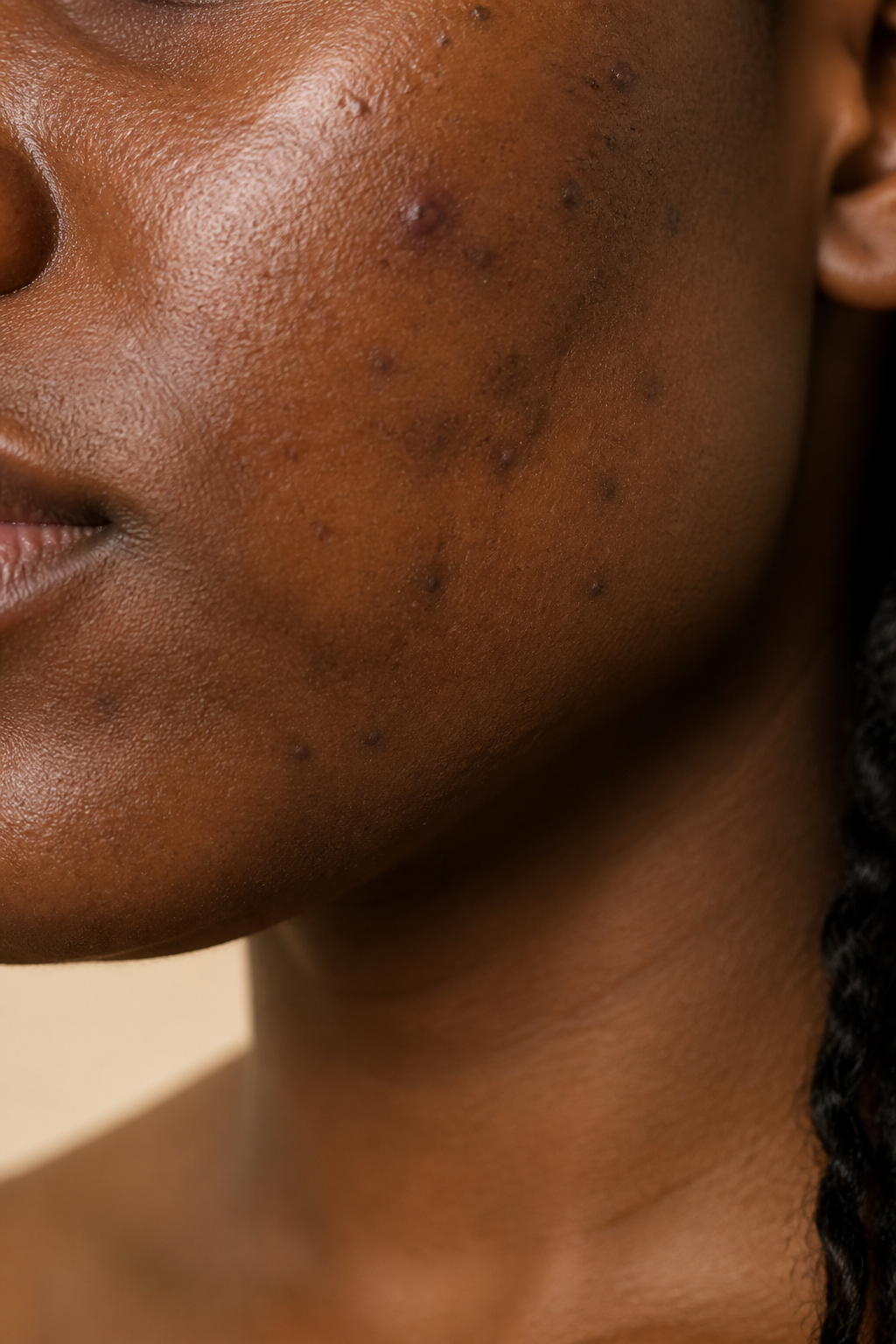
You faded the spot. Celebrated…. And then another one appeared.
So, you faded that one.
Then two more arrived.
At some point, hyperpigmentation starts feeling like a game of skincare Whack-A-Mole. But here’s the question we don’t ask enough:
Why are the new dark spots continuing to form?
Because treating existing pigmentation is only part of the conversation.
Understanding what’s triggering new discoloration matters too.
Hyperpigmentation Is a Response
Melanin gives our skin, hair, and eyes their color.
But pigment production can increase in response to several triggers.
One common example is post-inflammatory hyperpigmentation, or PIH.
After inflammation or injury, including acne, the skin may produce excess pigment in the affected area.
The blemish disappears, and the evidence stays behind.
If the Trigger Continues, New Marks Can Continue
Imagine spending months fading acne marks while still experiencing frequent inflammatory breakouts.
You’re addressing yeterday’s pigmentation while today’s inflammation may be creating tomorrow’s.
That’s why an effective hyperpigmentation strategy often needs two goals:
Address existing discoloration.
And:
Reduce preventable triggers for new discoloration whenever possible.
Acne Is One Trigger, Not the Only One
Hyperpigmentation can follow:
Acne
Picking or squeezing blemishes
Skin irritation
Cuts or Injuries
Certain Inflammatory skin conditions
Other forms of hyperpigmentation, such as melasma, have different and often more complex influences.
That distinction matters because not every dark spot should be treated exactly the same way.
Picking Makes the Situation Worse
We KNOW!
That whitehead is staring you down.
You’ve already positioned yourself three inches from the mirror, staring back at big Bertha.
Let me grab your hand... Step awayyyyyy from the crime scene.
Picking can increase trauma and inflammation, which may increase the likelihood or severity of post-inflammatory discoloration.
Especially if you’re already prone to PIH.
Sometimes, the best hyperpigmentation treatment begins with leaving the blemish alone.
Sun Protection Is Part of the Conversation
UV radiation can stimulate pigment production and make hyperpigmentation more persistent.
Visible light can also be relevant for certain pigmentary conditions, particularly in deeper skin tones.
That’s why daily broad-spectrum sunscreen belongs in a serious discoloration strategy.
Not just at the beach or during summer.
CONSISTENTLY.
Be Careful With the “Burn It Off” Mentality
When people become frustrated with pigmentation, the temptation is to attack it aggressively.
More acids. More exfoliation. Stronger treatments.
Faster, faster, faster!!
But excessive irritation can create inflammation, and inflammation can contribute to pigmentation.
CONGRATULATIONS! We havenow invented the skincare hamster wheel.
Treatment needs to be effective and tolerable.
Where Nyael Fits
Our philosophy toward uneven tone and blemish-prone skin is built around something simple:
Support correction without forgetting the health of the skin experiencing it.
Celestial Elixir was created as a nighttime botanical facial oil for a ritual centered around nourishment, balance, and radiant-looking skin.
It isn’t intended to replace prescription treatment or sunscreen, nor do we believe one bottle solves every cause of hyperpigmentation.
That’s precisely the point.
REAL skincare education shouldn’t require pretending one product does everything.
Treat the Skin, Not Just the Spot
Your dark spot has a history. Maybe it began with a breakout.
Maybe irritation. Maybe picking.
Understanding that history can help you make better decisions about what happens next.
Instead of endlessly asking:
“How do I fade this?”
Start asking:
“Why does my skin keep producing new marks?”
That question changes the entire strategy.
Because radiant skin isn’t just about correcting yesterday.
It’s about caring for the skin you’re creating tomorrow.
Your radiance was written in the stars.
